The client urgently requested on-site emergency service due to PCC power failure on board. If not handled promptly, the fault would escalate into complete breakdown of the whole power system, resulting in delayed departure after cargo loading. The fault must be rectified within the specified time limit to avoid port detention and disruption of subsequent voyage schedules.
In response to this urgent request and in return for the long-term trust and support from our client, we fully demonstrated our solid technical capability and sincere service commitment.
Part I: Equipment Overview & Fault Description
Our service technicians held on-site communication with ship duty officers and referred strictly to relevant official instructions and equipment operation manuals.
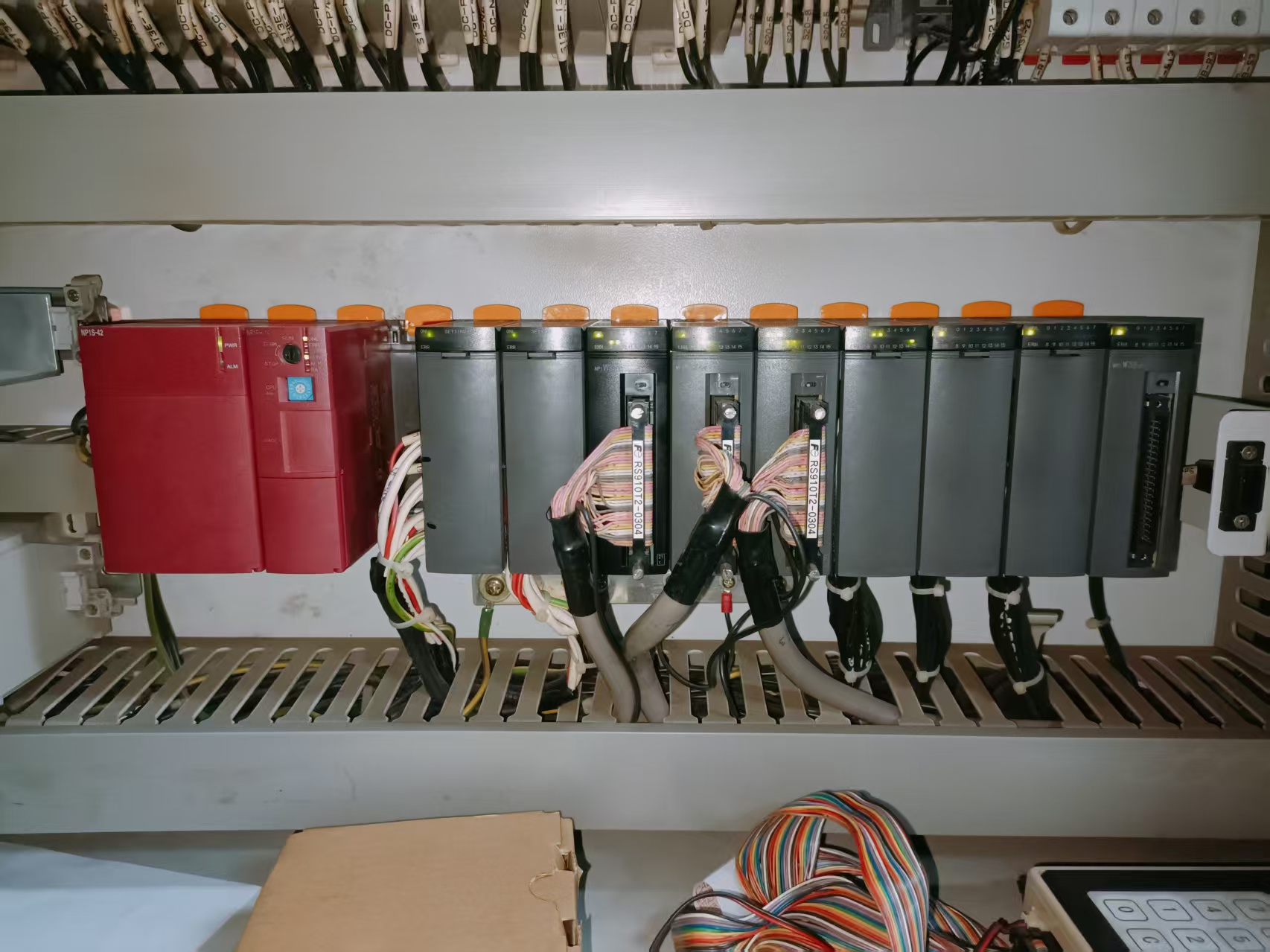
1. Fuji MICREX-SX SP marine generator PLC All grey modules of this controller are digital DI/DO switching modules, with no analog modules or independent communication modules equipped. It is mainly applied to generator start-stop control, safety protection and system interlock logic control.
2. Fault Description
-
Input Signal Fault: The corresponding PLC input indicator fails to light up when buttons, safety protection switches and limit switches are actuated.
-
Output Signal Fault: Oil pumps, solenoid valves and contactors cannot operate normally after control commands are issued by the internal program.
3. Fault Cause Summary & General Maintenance Idea Such simultaneous faults are mainly triggered by loose wiring caused by cabin vibration, damp salt fog corrosion, unstable power supply voltage and common circuit abnormalities. The standard maintenance principle is to firstly inspect the common power supply and general wiring condition, then troubleshoot input loops and output loops item by item separately.
Part II: Detailed Troubleshooting Procedures
The whole maintenance work was carried out in accordance with professional maintenance guidelines and our years of accumulated on-site technical experience.
2-1 Input Signal Fault
Phenomenon: The PLC input channel indicator remains off after relevant control switches are triggered.
Common Causes: Loose wiring connection, damaged field switches, burnt-out PLC input points
Detailed Troubleshooting Steps:
1. Observe the status of corresponding channel indicators and confirm they stay unlit.
2. Measure the voltage of on-site switches and contact loops to confirm stable 24V DC signal output.
3. Verify the connection of normally open and normally closed circuits to ensure correct wiring logic.
4. Fasten flat cables and terminal blocks, confirm no wire breakage or poor contact exists.
5. After confirming all external circuits and field components are in normal condition, judge that the internal PLC input point is burnt out.
6. Replace the faulty I/O module and perform functional test. All input indicators light up normally, and the fault is completely eliminated.
2-2 Output Signal Fault
Phenomenon: Executive components including oil pumps, solenoid valves and contactors fail to respond after program outputs control signals.
Common Causes: Burnt-out PLC output points, open load circuits, damaged executive components
Detailed Troubleshooting Steps:
1. Check the corresponding output address and confirm the PLC output indicator lights up normally.
2. Although the indicator is on, field equipment cannot operate; measure and confirm stable working voltage at module output terminals.
3. With normal terminal voltage detected, inspect load coils, intermediate relays and secondary control circuits, all parts are confirmed in good working condition.
4. Further inspect field executive components, and confirm the faults are caused by disordered internal coil wiring and insufficient electromagnetic suction due to coil aging. We replaced defective coils, implemented standard rewiring and conducted trial operation after completion.
5. The whole control circuit returns to normal state, all equipment can realize stable start and stop operation, and the fault is fully resolved.
Part III: Common Fault Reminders & Recommended Maintenance Solutions for Vessel Side
3-1 Common System Faults
Fault 1: No power supply, power indicator off
Common Causes: Power grid voltage fluctuation, blown fuse, aging power module
Recommended Troubleshooting Steps:
1. Measure external DC24V power supply and check the working status of incoming circuit breakers and fuses.
2. Check whether the wiring terminals of NP1S-42 power module are loose.
3. Re-seat all modules and fasten orange fixing buckles firmly.
4. If the power indicator remains off with normal external power input, confirm the power module is damaged and suggest timely replacement.
Fault 2: RUN indicator off after power-on, ERR indicator steady on or flashing
Common Causes: Poor contact induced by cabin vibration, instantaneous voltage surge, CPU hardware failure
Troubleshooting Steps:
1. Cut off power supply and restart the device after 30 seconds to eliminate temporary program crash.
2. Ensure all I/O modules are installed firmly and check for independent module alarm signals.
3. Remove redundant expansion modules and perform test operation only with power module and CPU module.
4. Inspect poor contact failure of program memory card socket.
3-2 Special Typical Faults in Marine Engine Room
1. Intermittent signal loss caused by mechanical vibration: Reinstall all functional modules and fully fasten all wiring terminals and internal connecting cables.
2.Metal oxidation failure caused by high humidity and salt fog: Clean wiring terminals in power-off state and implement effective moisture-proof protection measures.
3. Instantaneous voltage surge during generator start-stop: Install surge protection devices in power supply loops to stabilize input voltage.
3-3 General Standard Maintenance Sequence
Check power supply status → Observe panel indicator status → Fasten circuits and modules → Inspect external field circuits → Detect internal PLC channel points → Carry out module replacement test
Additional sharing of PLC trouble shooting on bulk carrier for more learning and better maintenance when need:
Similar hatch cover PLC malfunction issues on bulk carriers are documented in our on-site service report: <Zhoushan Bulk Carrier Hatch Cover PLC Maintenance Case>, including fault detection and parameter reset operations for deck control systems.
Part IV: Service Concept & Summary
During emergency troubleshooting and rush repair of various marine mechanical and electrical faults, every member in our team, including front-line on-site technicians and back-office technical support personnel, will face comprehensive professional assessment. It tests our practical technical experience, rigorous working attitude, overall organization and coordination capability, as well as our determination to deliver qualified services and fulfill all commitments to clients.
Abundant on-site experience is essential for marine voyage maintenance services, yet we attach more importance to the rigorous working attitude and professional dedication of every team member. We have always shared the same core belief: every minor hidden trouble we eliminate for vessels can provide more reliable safety guarantee for ocean-going navigation.
Potential navigation risks exist all over the vast sea. Devoting ourselves to safeguarding the safety of seafarers and vessels brings us far more value than economic returns. It is the best reward of client trust and the practical realization of maritime safety guarantee. Sticking to the mission of protecting personal life and navigation safety is always worthy of our persistence and pride.



 +8615005328513 (wechat ) +8613606393913 (Whatsapp)

 No. 8888, Huangshan Road, Huangdao District, Qingdao City, Shandong Province, China.