On-site Repair of Electric Anchor Windlass for Bulk Carriers in Zhoushan Shipyard
Hits: 871 Time: 2026.04.15
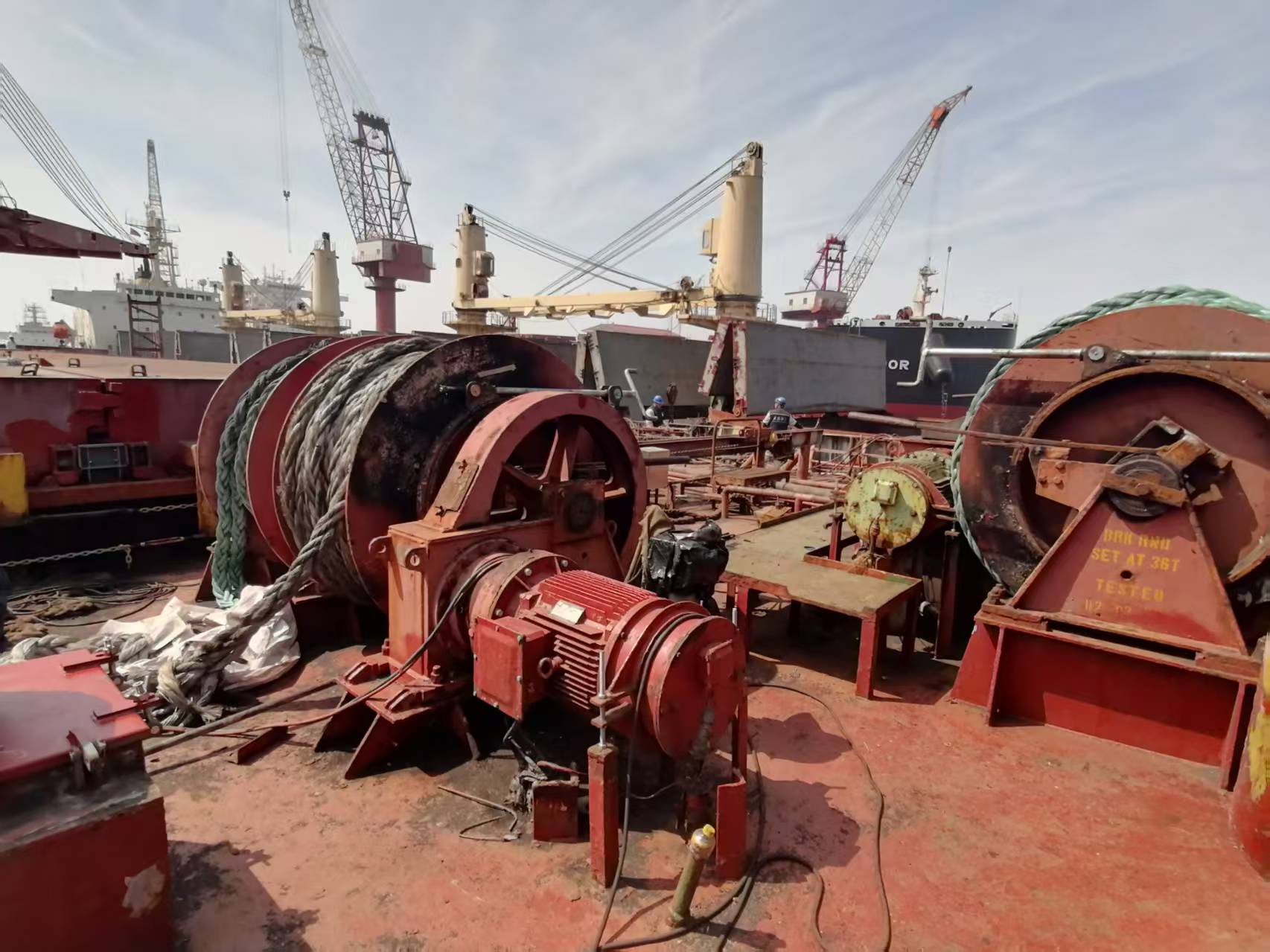
Zhoushan Shipyard Real-time Case: Quick Response to Sudden Anchor Windlass Failure
Even less popular for some old technical type equipment on board , we have no reason to refuse their maintenance service ordered by our steadfast client, the reason is simple: customer request first and try our best to provide maximum economic value basing on our professional teamwork
Just like this time, the electric anchor windlass on-site repair & trouble shooting in zhoushan shipyard:
We must admit the bright features of such electric windlass with compact structure, convenient maintenance and strong load-bearing capacity, cost-effective, simple in structure and energy-saving, but inferior to hydraulic ones in heavy-duty operations and harsh environments
Our duty is the maintenance of current electric windlass on board, because it is the core deck equipment on the forecastle of bulk carriers, mainly responsible for anchor handling and mooring line operations, and is a key device to ensure the safety of ship berthing and unberthing.
Part I: General description of structure & working principle of current electric windlass on board, coupled with trouble summary before any solution
1. Core Components:
(1) Power Unit: Three-phase asynchronous motor (the blue component in the picture), providing initial power for the equipment;
(2) Reduction Unit: Gearbox, converting the high-speed small torque of the motor into the low-speed large torque required by the drum;
(3) Actuating Unit: Double drums, respectively wound with mooring lines for retraction and release operations;
(4) Braking Unit: Mechanical brake device, used to lock the drum after operation to prevent cable slippage;
(5) Control Unit: Electrical control cabinet, realizing forward/reverse rotation and start/stop control of the motor.
2. Working Principle
When the motor is energized, it rotates at high speed. Through multi-stage deceleration of the gearbox, power is transmitted to the drum shaft, driving the drum to rotate forward/reverse to complete the retraction and release of the cable. After the operation, the mechanical brake locks the drum to ensure mooring safety.
3. Trouble summary on board with deck crew before conducting any solution
3.1 Motor fails to start / Starts Weakly
3.2 Motor Overheating / Tripping
3.3 Drum Brake Failure / mooring line Slippage with brake fully engaged
PART II: Trouble shooting with standard procedure conducted on-site
1. Motor Fails to Start / Starts Weakly
Fault Phenomenon: When the start button is pressed, the motor has no response, or the rotation speed is extremely low after starting, unable to drive the drum.
Troubleshooting Steps:
(1)Electrical Circuit Check: Check whether the main power supply and control circuit voltage are normal, whether the contactor and thermal relay are tripped, and whether the terminal blocks are loose
Found : Three-phase power is unbalanced, one phase is missing (0V).
(2)Motor Body Check: Use a megohmmeter to detect the insulation resistance of the motor winding, and check for winding short circuit and grounding faults; check whether the motor bearing is seized and the rotor is rubbing the stator;
Found: Motor winding insulation is good, no short circuit, no grounding;Bearing and rotor are in normal condition.
(3) Load Check: Manually turn the drum to check whether the drum and gearbox are stuck, whether the brake is not fully released, and eliminate the problem of excessive mechanical load
Found: No excessive mechanical load, break fully released, the drum and gearbox are not stuck
Final result:
After electrical circuit and motor body inspection:Three-phase voltage is unbalanced with one phase missing, while motor insulation, bearing and rotor are all normal.This confirms the fault is single phasing (loss of one phase) in the power supply.
2. Motor Overheating / Tripping
Fault Phenomenon: After the equipment runs for a period of time, the motor temperature rises sharply, the thermal relay trips, and continuous operation is impossible.
Troubleshooting Steps:
(1) Load Check: Check whether the cable tension is overloaded and the drum is stuck causing the motor to run under long-term overload;
Found No overload exist
(2) Heat Dissipation Check: Check whether the motor cooling fan is damaged and the cooling air duct is blocked by dust and oil;
Found the cooling air duct is clear without any obstruction
(3) Voltage Check: Check whether the three-phase voltage is balanced, and whether there is phase loss and low voltage.
Found Three-phase voltage is unbalanced with one phase missing
3. Drum Brake Failure / mooring line Slippage with brake fully engaged
Fault Phenomenon: After the brake is locked, the drum can still rotate, the mooring line slips, posing a major hidden danger to mooring safety.
Troubleshooting Steps:
(1) Brake Mechanism Check: Check the wear of the brake shoes, whether the brake spring is fatigued or broken, and whether the brake disc has oil contamination or wear;
Found brake shoes heavily wearing, need to renew
(2) Clearance Adjustment Check: Check whether the brake clearance is too large to effectively clamp the brake disc;
Found the break clearance in normal range, no need adjust
(3) Hydraulic/Pneumatic Auxiliary Brake (if equipped): Check whether the auxiliary brake pressure is normal and whether the pipeline is leaking. Not application for this particular electric windlass
4. Basing on above mentioned on-site trouble checking and analysis, here we give below solution for ship decision
(1) Renew the current motor with new one -- finally solve the problem of phase lose which cause the trouble of Motor Fails to Start / Starts Weakly and Motor Overheating / Tripping
(2) Renew the brake shoes with new spare, meanwhile welding new cover for the bull gear connected the gear box
(3) Adjust the break clearance after new brake shoes renew process
(4) Keep enough brake spring for renew when needed, keep clean of the brake disc without any oil contamination
(5) Refill the hydraulic oil in the gear box or change with new hydraulic oil if need
PART III: Trouble shooting solution had been done and recommend routine maintenance key points in the future
1. After renew with new motor and brake shoes, welding the new cover for bull gear, filling the hydraulic oil in gear box and adjust the brake clearance, conducted on-site load test, found motor starting failure,Overheating / Tripping and brake failure had been solved in total, also not found any abnormal noise from gear box exist
2. Routine Maintenance Key Points
(1) Regular Lubrication: Replace the gearbox lubricating oil and motor bearing grease regularly according to the equipment manual, check the oil level and oil quality to avoid dry grinding;
(2) Brake Inspection: After each berthing and unberthing operation, check the brake performance, adjust the brake clearance, and replace worn parts;
(3) Electrical Maintenance: Regularly check the terminal blocks of the motor and control cabinet, clean dust and oil, detect insulation resistance, and prevent electrical faults;
(4) Structure Inspection: Check the tightness of the drum, gearbox and anchor bolts, tighten loose parts in time, and check for cracks and corrosion;
(5) Environmental Protection: Do a good job in waterproof and salt spray protection of the equipment to avoid seawater corrosion leading to component rust and jamming.
PART IV: Write at the end
The electric anchor windlass is the core equipment for deck operations of bulk carriers, and its operating status is directly related to the safety of ship berthing and unberthing. Ship engineers should master the equipment structure and principle, establish a standardized troubleshooting process for common faults, and strictly implement the routine maintenance system, which can effectively reduce the equipment failure rate, extend the service life, and ensure the safety of ship operation.
For professional ship anchor windlass repair, maintenance and spare parts supply services, please feel free to contact Qingdao Sealink Marine Service Co., Ltd. We provide professional ship repair services nationwide to escort the safety of your ships.
To learn more about related marine equipment inspection, calibration and on-site repair services, you may check our technical article:
<Ship Bunker Crane Slewing Bearing Renewal>



 +8615005328513 (wechat ) +8613606393913 (Whatsapp)

 No. 8888, Huangshan Road, Huangdao District, Qingdao City, Shandong Province, China.