Emergency Repair of Bulk Carrier Hatch Cover Radial Piston Motor at CUD Shipyard for Safe Navigation & Cargo Security
Hits: 1376 Time: 2026.04.13
Emergency Hydraulic System Repair for Bulk Carrier Hatch Cover Radial Piston Hydraulic Motor at CUD Shipyard
Entrusted by our long-term client to repair the hatch cover radial piston hydraulic motor, which had failed to perform normal opening and closing functions since the last cargo discharge. To avoid any risk of cargo damage and PSC delays for the vessel’s next voyage, the issue required urgent and thorough resolution during the ship’s stay at the shipyard.
Part I: On-site Inspection & Troubleshooting
1. Immediately arranged experienced hydraulic technicians on board for fault diagnosis.
2.Held a pre-repair meeting with the duty officer and crew. The deck crew reported insufficient hydraulic power for hatch cover operation. Engine department confirmed that other hatch cover radial piston motors operated normally under the same main hydraulic pump pressure. This strongly indicated an internal fault within the problematic motor itself.
3. Based on crew feedback, our hydraulic technicians proceeded to conduct on-site inspection of the faulty motor.
4. During inspection, aged hydraulic hoses and minor oil leakage were observed. The motor drove the hatch cover at extremely low speed, accompanied by loud abnormal noise from inside the motor. The motor was then stopped, and an on-site repair plan was formulated and implemented accordingly.
Part II: Detailed Repair Process
1. Replaced all aged and leaking hydraulic hoses with new ones and properly tightened all connections to ensure no leakage and stable pressure during motor operation.
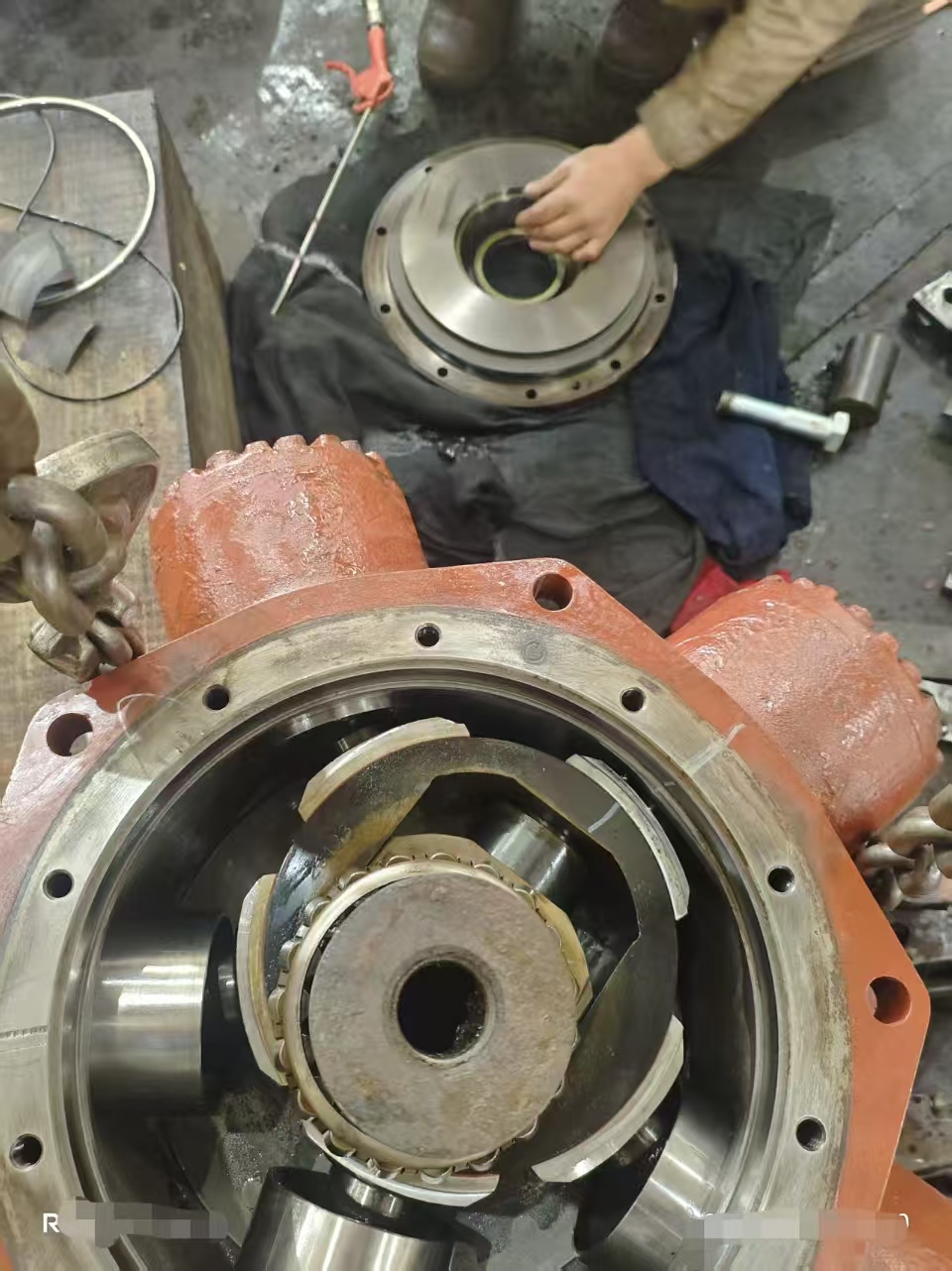
2. Due to severe abnormal noise during operation, professional tools were prepared to dismantle the radial piston motor for root cause analysis.
2.1 Removed the end cover of the radial piston motor.
2.2 Disassembled the output shaft and flange assembly.
2.3 It was found that one piston roller had deviated from its normal meshing position and was completely embedded into the cam groove of the star wheel, resulting in abnormal meshing and functional failure.
2.4 Potential consequences caused by the embedded piston roller:
(1) Transmission failure: The roller could not drive the piston properly, leading to a significant drop in output torque and flow, or even complete malfunction.
(2) Component damage: During star wheel rotation, the roller impacted the cam groove abnormally, causing secondary damage to the cam groove, roller and piston. In severe cases, it could result in star wheel fracture and piston cylinder block scrappage.
(3) Hydraulic system instability: Piston seal failure would cause internal leakage and pressure fluctuation, affecting the entire hatch cover hydraulic system.
2.5 Possible root causes for the piston roller embedding into the star wheel cam groove, based on our experience:
(1) Fatigue or fracture of the piston return spring
(2) Piston seizure or scoring in the cylinder bore
(3) Roller bearing seizure
(4) Excessive wear of the star wheel cam groove forming a deep recess
(5) Sudden load shock or hydraulic pressure shock
2.6 Targeted troubleshooting:
(1) Gently pulled and pushed the piston using appropriate tools.
(2) Confirmed the piston was not seized or tight.
(3) The piston moved easily with no rebound force → return spring was broken or fatigued.
(4) The roller rotated smoothly → bearing was in good condition.
Final root cause confirmed: Failure of the piston return spring.
A new piston return spring was installed, and the entire radial piston motor was reassembled in the correct sequence.
2.7 Post-repair on-site test showed that the radial piston hydraulic motor operated smoothly. The hatch cover opened and closed at the designed speed and full stroke without any abnormal noise.
Part III: 5 Daily Operation & Maintenance Recommendations for Hatch Cover Radial Piston Hydraulic Motor
1. Conduct routine maintenance regularly. Promptly replace aging hydraulic hoses to prevent insufficient hydraulic oil pressure, which may affect the opening and closing speed of the hatch cover and lead to cargo damage.
2. Avoid rough operation during daily opening and closing of the hatch cover, as such behavior is likely to cause damage to the hydraulic piston reciprocating motor.
3. Immediately stop operation and investigate the cause once any abnormal phenomena or noises are detected.
4. In cold winter weather, after starting the piston reciprocating motor, allow it to warm up for a period of time before performing any operation.
5. Clean the hatch cover closing rails in a timely manner after loading and unloading to ensure unobstructed and resistance-free closing of the hatch cover.



 +8615005328513 (wechat ) +8613606393913 (Whatsapp)

 No. 8888, Huangshan Road, Huangdao District, Qingdao City, Shandong Province, China.