We maintain a rapid response mechanism to promptly accept shipowners’ maintenance commissions.
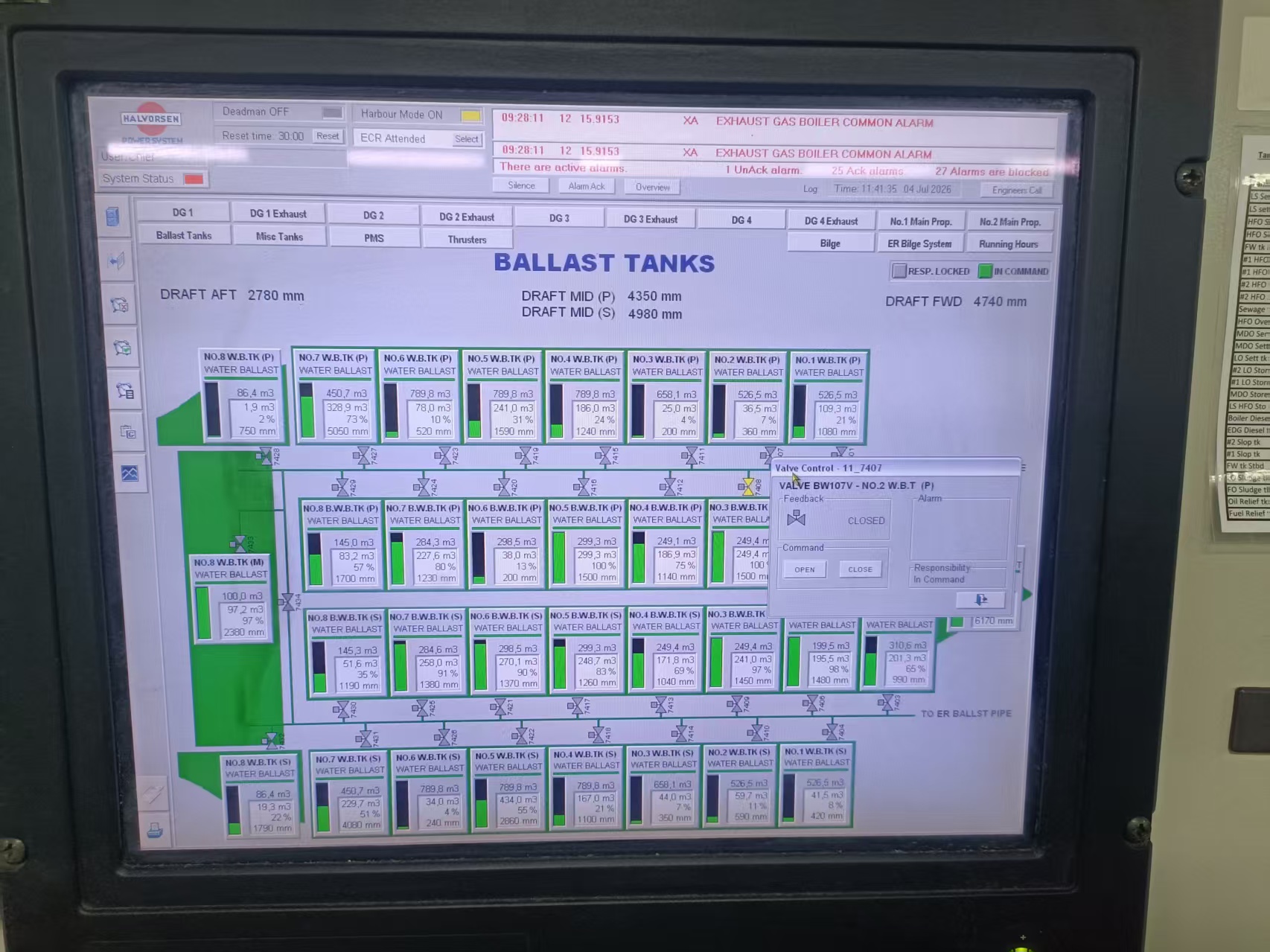
The faulty vessel in this case is a bulk carrier. While berthed at Jingtang Port for cargo discharging and performing ballast water trimming operations, the touchscreen of the Halvorsen PMS full-engine room integrated monitoring platform in the engine control room triggered the exhaust gas boiler general alarm. The persistent alarm pop-up locked the screen’s operating permissions, disabling ballast tank liquid level monitoring and remote valve control functions, while real-time monitoring of the exhaust gas boiler operating conditions became abnormal.
The ship’s crew failed to completely eliminate the fault after self-inspection, which potentially leading to delay ship departure plan and off-hire risk following with huge economic lose and reputation degrading to ship owner.
No reason for refuse and slow response from our side, so fast dispatching our marine automation engineers to board the vessel for maintenance.
Part I: Fault Inspection & Summary
1. Basic Equipment Introduction
The Halvorsen PMS is not an independent display screen dedicated to the ballast system, but a complete integrated monitoring platform covering the entire engine room. A single hardware terminal and touchscreen integrate multiple monitoring and control functions, including ballast tank liquid level collection, exhaust gas boiler condition monitoring, liquid level detection for various tanks, and remote valve operation.
This is the core reason why the exhaust gas boiler alarm pop-up appears on the ballast system touchscreen: all equipment alarm signals and real-time operating data from the engine room are collected and connected to the same master control system, and uniformly displayed on this touchscreen.
2. Visible Fault Phenomenon
A persistent red alarm prompt is displayed on the main interface of the touchscreen, with the alarm text: EXHAUST GAS BOILER COMMON ALARM.
3. Inherent Connection Between the Ballast System and Exhaust Gas Boiler
(1)Shared seawater pipeline: Only one set of main seawater pipelines is arranged at the vessel’s sea chest. The pipeline is divided into two branches: one supplies seawater to ballast pumps and all ballast tank inlet and outlet valves; the other connects to the cooling circuit of the exhaust gas boiler. The valve position feedback signals of both sets of equipment are uniformly connected to the Halvorsen PMS touchscreen.
(2) Mutual restriction of operating conditions: Large-scale water pumping operations of the ballast system will divert seawater from the main pipeline,resulting in insufficient cooling medium flow of the boiler and further triggering the general boiler alarm.
4. Comprehensive Analysis of Fault Inducements
This fault is not caused by a single issue but a superposition of multiple factors, which are divided into four main inducements:
(1) Seawater main pipeline flow competition: The core underlying inducement. Large-flow water intake during port ballast trimming occupies the seawater supply for boiler cooling.
(2) Restricted opening parameter of ballast valves: An easily overlooked software problem. Factory-set system parameters lock the maximum opening of valves, extending the duration of ballast trimming operations.
(3) Shared signal circuit interference: The feedback signals of ballast seawater valves and boiler cooling valves share the same input circuit, and abnormal signals can easily trigger the general alarm in linkage.
(4) System program residual alarm bug: After the condition fault is resolved, the alarm signal cannot be automatically cleared, and the pop-up window continuously locks screen operations.
Faults are divided into two basic types for on-site troubleshooting:
Type A: Only abnormal system alarm pop-ups, all actual operating parameters of the boiler are normal, the alarm interface locks the screen, and access to the ballast monitoring page is unavailable.
Type B: Condition linkage fault. Abnormal ballast tank liquid levels and seawater pipeline flow lead to insufficient cooling water supply for the boiler, and real abnormal equipment operating conditions trigger the alarm.
Superimposed faults may also exist: the boiler alarm displayed on the screen is only a superficial phenomenon, and the root cause of the fault actually comes from abnormal ballast system valve feedback or unbalanced tank liquid levels.
5. Basic Troubleshooting Principles
(1) Prioritize retaining the original alarm records on the screen, retrieve ballast tank liquid level and valve feedback interface parameters to initially distinguish fault types.
(2) Perform alarm acknowledgment and temporary alarm shielding operations as targeted based on fault types.
(3) Trace and resolve the underlying root fault, complete alarm reset, and fully verify the recovery of monitoring functions for the ballast system and exhaust gas boiler.
Part II: Standardized On-site Troubleshooting Procedures
Core Critical Principle
It is strictly prohibited to click the alarm clearing button to eliminate alarms directly. Once the original records of alarm time, flow rate and liquid level are lost, it will be impossible to accurately locate the root cause of the fault, and the fault will easily recur repeatedly.
Step 1: Fully Retain Fault Information (Highest Priority Operation)
(1) Take a complete full-screen photo of the touchscreen to retain the alarm code, alarm trigger time and real-time vessel operating conditions.
(2) Recorded the vessel draft / depth at the time of the alarm and the ongoing operations to confirm whether large-scale ballast trimming is being carried out simultaneously.
(3) Open the system Alarm Log page to check the frequency of alarm generation, and distinguish instantaneous one-time alarms, continuously repeated alarms, and residual alarms that cannot be reset after fault elimination.
Step 2: Bypass Access to Interface and Local Instrument Data to Ultimately Distinguish Fault Types
Due to residual system signals in the later stage of the fault, the alarm pop-up locks the conventional touch control operations of the touchscreen, and technicians cannot directly switch monitoring pages. Direct alarm clearing is forbidden on site to avoid losing fault data. Two methods are adopted to read core parameters as follows:
(1) Enter the engineer’s exclusive authority password to temporarily unlock the interface viewing permission, without performing alarm reset operations, completely retain the alarm log, and separately retrieve ballast tank liquid level, valve feedback parameters, as well as real-time cooling seawater flow and temperature data of the exhaust gas boiler.
(2) If there is no engineer operating authority, go to the local instrument cabinet in the engine room to read the main seawater pipeline pressure, boiler inlet and outlet water temperature, and ballast pump operating load on site for cross-verification of data.
Recommended Fault Troubleshooting and Judgment Standards
(1) Ballast system side data: Enter the [BALLAST TANKS main interface], check the real-time liquid level and tank capacity data of each ballast tank one by one; check the switch status and feedback opening of all seawater inlet valves and ballast pump outlet valves to confirm whether multiple valves are opened synchronously for large-flow water intake.
(2) Exhaust gas boiler side data: Switch to the boiler monitoring interface,retrieve the real-time cooling seawater flow, medium temperature and operating pressure parameters to confirm whether the current operating conditions of the equipment are normal.
Judgment Standards:
(1) If the boiler flow and temperature parameters are obviously abnormal, and the ballast system is running at high flow → real condition linkage fault is the primary cause.
(2) If all parameters of the boiler are completely normal, only the alarm pop-up window persists on the screen → pure residual alarm bug of the system.
(3) If the operating conditions have recovered, but the alarm cannot be eliminated → superposition of the two situations, which is the case of this fault.
Combine all the read data to distinguish fault types: It is found that the cooling seawater flow and temperature of the boiler are obviously abnormal, and multiple tanks perform ballast water pumping synchronously. It is confirmed that this fault belongs to a condition linkage fault where the boiler alarm is linked to the ballast system.
Step 3: Targeted Fault Handling by Type
According to the data verification in Step 2, this fault is a superposition of a condition fault and a system residual alarm bug. The unbalanced seawater load is the underlying root cause of the fault, so the seawater flow shortage condition problem is handled first, followed by resolving the residual alarm pop-up window issue.
(1) Handling of Condition Linkage Fault to Resolve Insufficient Main Seawater Pipeline Flow
(1) Coordinate with deck and engine room duty officers to adjust the operation rhythm, suspend synchronous water replenishment of some ballast tanks, reduce the total operating load of ballast pumps, and cut down the water intake of the main seawater pipeline.
(2) Continuously monitor the cooling seawater flow and medium temperature of the boiler. After the parameters return to the safe range and stabilize, perform the [Alarm Acknowledgment] operation to clear the alarm pop-up window on the main interface.
(3) Check the opening control parameters of remote ballast valves: it is found that the factory-set system parameters limit the maximum opening of the valves. With the written authorization of the shipowner and equipment manufacturer, adjust the valve instruction upper limit to 100% rated opening, shorten the overall duration of ballast trimming operations, and reduce long-term seawater diversion problems.
(2) Handling of System Residual Alarm Bug to Eliminate Persistent Alarm Pop-ups
(1) Prioritize calling the system’s built-in alarm acknowledgment and global reset functions to test whether the alarm pop-up window can be automatically eliminated.
(2) If the reset operation is invalid, temporarily shield this non-emergency equipment alarm under engineer authority, unlock the full operating permissions of the touchscreen, and prioritize restoring core functions including ballast tank monitoring and remote valve control.
(3) Optimization suggestions for the shipowner: Select an appropriate time to complete the firmware upgrade of the Halvorsen PMS system to repair residual signal defects from the underlying program.
Step 4: Continuous Full-function Retest and Verification
After completing alarm elimination and system parameter adjustment, conduct a 30-minute full operating condition verification test:
(1) Switch repeatedly between the ballast tank and exhaust gas boiler monitoring interfaces to confirm that data such as tank liquid level, valve opening feedback and cooling water temperature are refreshed in real time without delay.
(2) Remotely operate 1~2 ballast valves to complete opening and closing actions, and confirm that control instruction issuance and valve position feedback transmission are synchronous and normal.
(3) Simulate small-scale ballast trimming operations, continuously observe that the cooling seawater flow and temperature of the boiler remain stable, and the general alarm will no longer be triggered repeatedly.
All functional tests show no abnormalities, and the on-board maintenance work for this case is completed.
Part III: Maintenance Conclusion & Daily Operation and Maintenance Optimization Suggestions
1. Fault Summary Conclusion
This EXHAUST GAS BOILER COMMON ALARM general alarm fault is a dual superposition problem of "exhaust gas boiler operating condition abnormality caused by seawater diversion during ballast trimming operations + residual alarm bug of the Halvorsen PMS system".
There is no hardware damage to the exhaust gas boiler itself. The core root cause of the fault is the unbalanced load of the full-vessel main seawater pipeline caused by large-scale ballast operations during port cargo unloading, superimposed with program defects of the older version monitoring system, which ultimately results in the alarm pop-up locking the screen.
2. Long-term Operation and Maintenance Optimization Plan
Ballast water trimming during port loading and unloading is a rigid operation to ensure vessel stability and cannot be stopped directly. The core optimization idea is to balance the seawater system load of the entire vessel to avoid the repeated occurrence of similar linkage alarms.
(1) Operation Management Level (Zero Cost, Fastest Effect)
Establish a two-way communication mechanism between the deck team and engine room duty officers:
① Before the deck carries out synchronous large-scale ballast trimming of multiple tanks, notify the engine room duty officers in advance.
② The engine room evaluates the current operating load of seawater-consuming equipment such as exhaust gas boilers and fresh water generators in real time, and both parties coordinate to stagger high-load water intake operations.
Avoid synchronous water intake and drainage of multiple ballast tanks, split trimming steps and complete them in batches, smooth the flow peak of the main seawater pipeline, and eliminate instantaneous sharp drops in seawater flow that trigger boiler alarms.
(2) System Parameter Setting Level
① Regularly check the maximum opening control parameters of remote ballast valves, optimize trimming efficiency on the premise of compliance and no pipeline impact risks, and shorten the total duration of large-scale ballast operations.
② Appropriately adjust the judgment delay of the exhaust gas boiler general alarm to filter instantaneous small fluctuations in flow during port operations and avoid brief disturbances directly triggering the general alarm.
Important Red Line Reminder: Only moderately extend the alarm judgment time; it is strictly prohibited to directly turn off the boiler general alarm function to prevent potential safety hazards caused by equipment overheating.
(3) Hardware Equipment Maintenance Level
Clean the front filter of the seawater pipeline regularly, inspect the sea chest grille for blockages by marine organisms and sundries regularly, improve the maximum flow capacity of the main seawater pipeline, raise the upper limit of full-vessel seawater supply from the source, and reduce the flow gap caused by simultaneous water intake of multiple equipment.
Part IV: Final Thoughts
No completely independent single piece of equipment exists among marine engine room automation equipment. All types of equipment form deep linkages relying on seawater pipelines and signal transmission circuits, which is the underlying logic for the existence of a complete integrated monitoring system.
Any complex control system and equipment design are essentially built and combined step by step from basic electrical components and underlying control programs. Years of on-board maintenance practice have confirmed a core troubleshooting criterion: the core idea of fault troubleshooting is to first thoroughly understand the underlying operating principles and control logic of single equipment, sort out the complete architecture and working procedures of the entire system from a macro perspective, and then drill down to tiny components such as circuits, valves and control modules for one-by-one verification and fault location.
A complete automation system can be built from small to large and from simple to complex. For practitioners engaged in marine electrical automation maintenance, as long as the underlying logic of equipment linkage and the operating principles of equipment are fully understood, there is no need to fear various complex and difficult faults. Solid professional confidence and maintenance capabilities will also be gradually established through continuous in-depth research and repeated on-board practice.


 +8615005328513 (wechat ) +8613606393913 (Whatsapp)

 No. 8888, Huangshan Road, Huangdao District, Qingdao City, Shandong Province, China.