How to effectively maintain high shipping speed while improving fuel efficiency, reducing operating costs, increasing shipowner benefits, and protecting the marine environment and ecological balance has long been a key focus for shipowners, ship management companies, and relevant authorities. Here we recommend a direct and effective solution with immediate results: underwater marine growth cleaning by professional divers using pneumatic cleaning tools, supplemented by robotic equipment where necessary.
As entrusted by the client, we carried out underwater marine growth cleaning for a 290m LOA, 45m beam bulk carrier at Qingdao Port on 06 April 2026.
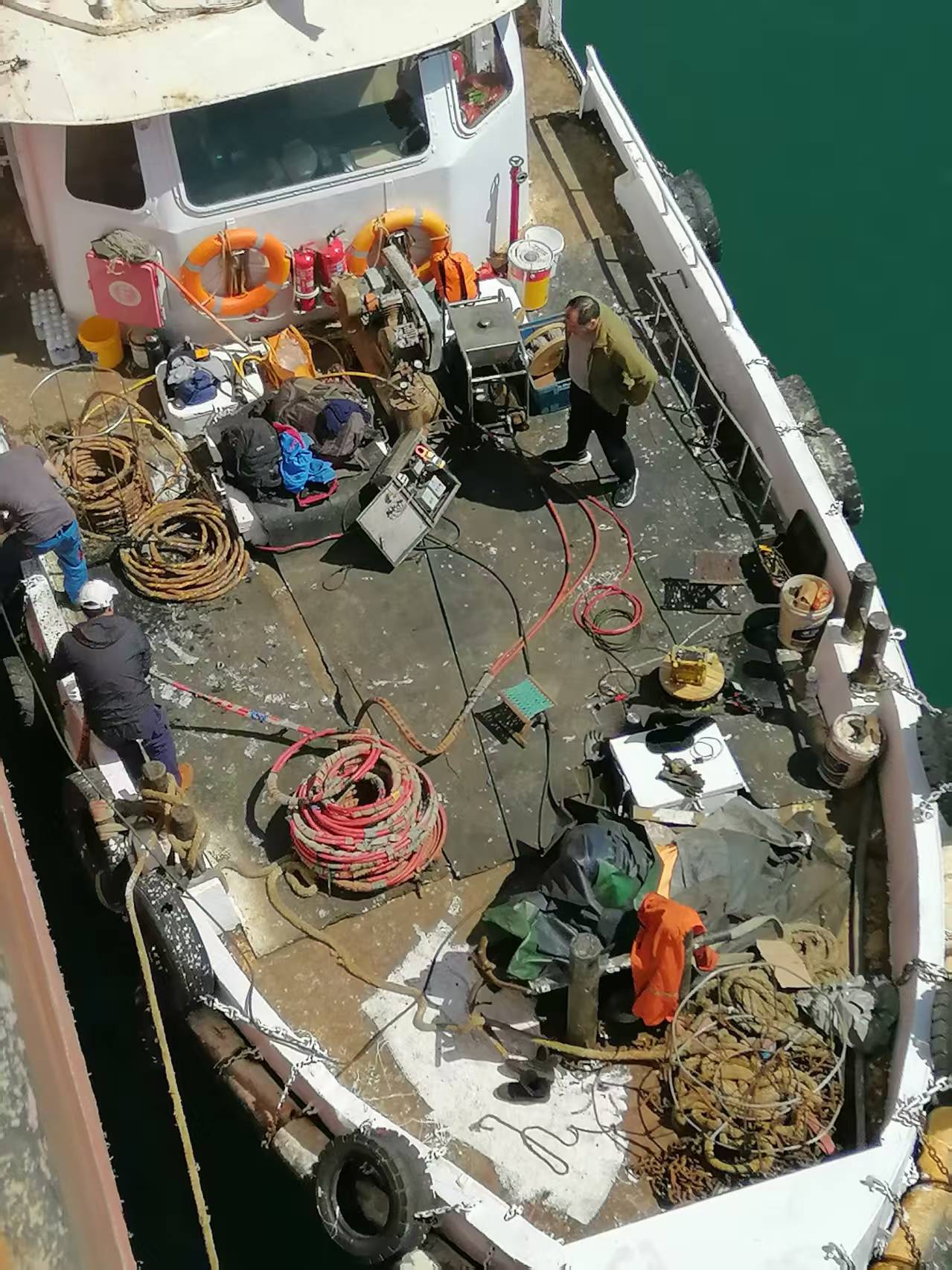
To complete the underwater cleaning within the limited time window, we mobilized a full team of qualified divers and assistants, equipped with sufficient cleaning tools and deployed two service support vessels to the port side of the bulk carrier early in the morning to commence the planned underwater operations.
After the two support vessels were secured at the port bow and port stern, the diving supervisor boarded the ship via the embarkation ladder and aluminum gangway.
On board, the supervisor met the Chief Officer and Chief Engineer in the ship’s office to discuss service details, including the scope of work, planned duration, required shipboard cooperation, and critical equipment that must be closely monitored or stopped if necessary to ensure diver safety. Meanwhile, the underwater cleaning checklist was completed by the duty ship’s crew and engineers (Chief officer and Chief engineer ).
PAR I: Preparation for underwater cleaning :
1. Power cables (for air compressors and related electrical machinery) were prepared, sent from two support boats and connected to the ship’s power supply (440V/32A/12KW) by the ship’s electrician.
2. Divers prepared their full diving equipment, including diving suits, helmets, back-mounted air cylinders, regulators, lead weights, and fins, with underwater cameras ready for use.
3. Once fully prepared, 3 divers entered the water from the forward and aft vessels respectively. Assistants on boats managed the air hoses, while the team leader monitored real-time underwater marine growth conditions via the monitor and maintained constant communication with the divers and guide them for some potential area need to be careful checked , ensure the whole underwater sea growth on ship hull had been measured totally
4. After the 3 divers returned to the boats with sufficient photos and videos showing the hull’s marine growth distribution — including side shell, bottom shell, rudder, propeller, sea chest, and bow area — a detailed cleaning plan was formulated accordingly.
PART II: Details underwater cleaning conducted as below :
1. Two divers began from the aft vessel, using pneumatic brushes to clean the stern area (longitudinally from midship to stern for side shell, transversely from port to starboard for bottom shell), including the rudder, propeller, sea chest, and other components.
2. One diver was assigned to clean the bow area (longitudinally from midship to forward for side shell, transversely from port to starboard for bottom shell), including the bulbous bow and bow thruster.
3. Dive assistants on the boats managed the air hoses and pneumatic tool hoses. The team leader maintained timely communication with underwater divers to assess cleaning progress and provide on-site guidance. All divers were continuously reminded to preserve the integrity of the ship’s anti-fouling coating, which is fundamental to effective underwater cleaning.
4.Divers took scheduled rotations within reasonable time intervals to ensure high cleaning efficiency, adequate rest, and avoidance of fatigue operations, putting safety as the top priority.
5.The diver on the third rotation completed the remaining cleaning work and conducted a final inspection, capturing post-cleaning videos and photos to confirm no areas were missed. All cleaning was fully performed in accordance with the client’s requirements.
6. All pre- and post-cleaning videos and photos were submitted to the ship’s crew. The service scope and quality were clearly demonstrated through the visual records, and the ship side expressed full satisfaction with the cleaning, then signed and stamped our service report.
7. All equipment was secured on the support vessels. Once the mooring lines were released, the entire diving team departed the ship and returned safely to shore.
PART III: The adverse effects of marine growth on a ship’s hull are easy to understand
It is like a person swimming in the sea wearing thick, heavy clothing — clumsy and weighed down. How can one expect fast speed and flexible movement with minimal physical effort?
The same applies to ships. Every aspect of a vessel’s design is intended to achieve optimal seaworthiness and economic efficiency. Thick layers of marine growth on the hull completely undermine its original design intent and economic performance.
Useful Recommendations to Reduce Marine Growth on Vessels
1.Conduct regular underwater cleaning to remove marine growth and avoid increased fuel consumption
2.Vessels operating in tropical or warm waters require more frequent cleaning.
3.Perform targeted cleaning for ships at anchor for extended periods.
4.The stern area typically accumulates thicker marine growth and needs extra attention.
5. Apply high-performance anti-fouling coatings to the hull, and arrange timely maintenance or renewal when necessary.
6.Avoid hull structural damage, as damaged surfaces accelerate marine growth attachment.
7.Maintain proper vessel trim to optimize hydrodynamic performance and further improve fuel efficiency.



 +8615005328513 (wechat ) +8613606393913 (Whatsapp)

 No. 8888, Huangshan Road, Huangdao District, Qingdao City, Shandong Province, China.