Bulk Carrier Cargo Hold Remote Monitoring System(KEI 3240 AGU IV)Troubleshooting at CUD Shipyard
To maintain normal alarm status for vessel structural integrity, prevent potential catastrophic hazards to the ship, crew and marine environment.
Various alarms must be continuously monitored on board to ensure vessel safety, especially for cargo hold liquid level, internal temperature, gas concentration and pressure. These parameters require timely monitoring, which necessitates the installation of a professional remote monitoring system. All shipboard systems require periodic routine maintenance. However, abnormal faults often occur due to harsh operating environments, affecting the normal operation of the monitoring system.
In response to the above monitoring system faults on a bulk carrier berthed at CUD Shipyard, our company dispatched an experienced electrical technician to carry out on-board troubleshooting, based on long-term cooperation and client trust.
Part I: On-site General Information & Technical Overview
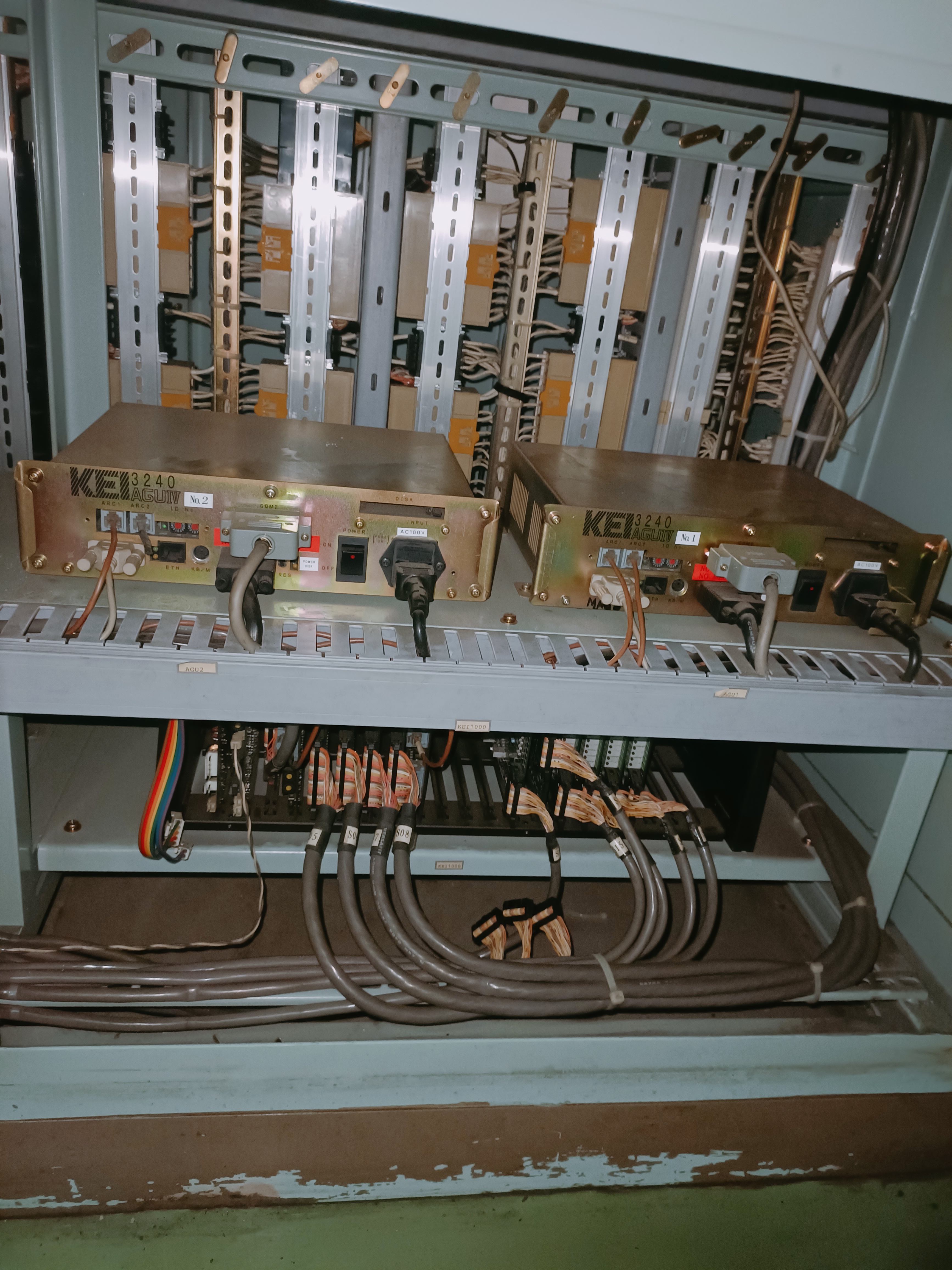
1. This is the KEI 3240 Data Logger manufactured by KEI SYSTEM Co., Ltd., Japan. As a core piece of ship engine room automation equipment, it is widely installed in the engine room or control room of bulk carriers and other vessels, serving as an important part of the ship’s Integrated Automation System (IAS) and data logging system.
2. The system is equipped with two main control CPU units, marked No.1 and No.2, adopting a dual redundant backup configuration.
2.1 Main Functions
(1) Real-time collection and recording of main engine and auxiliary engine operating data, including temperature, pressure, rotation speed, fuel consumption and other key parameters, supporting data analysis and alarm tracking.
(2) Continuous monitoring of equipment operating conditions with complete alarm functions and visual interface, facilitating timely response by duty officers and crew.
(3) Assisting in equipment performance analysis, fault diagnosis and energy management, so as to eliminate hidden dangers and avoid major accidents in advance.
2.2 Cabinet Internal Structure
(1) Upper section: Two sets of KEI 3240 data acquisition units operating in mutual redundancy.
(2) Middle and lower sections: I/O terminal blocks, cable management accessories and power distribution modules.
(3) Overall: The whole assembly constitutes a complete engine room data acquisition and monitoring system.
3. Existing on-site faults are summarized as follows:
3.1 False alarms and signal fluctuation in partial cargo holds
3.2 Sensor data loss and signal disconnection
3.3 Dual redundant unit switching failure
3.4 System storage failure (logs & historical data cannot be saved)
Part II: Standard Troubleshooting & Maintenance Solutions
3.1 False alarms and signal fluctuation
Solutions:
(1) Inspect on-site cabinets and fasten all loose terminal screws with professional tools.
(2) Clean oxidized and corroded connectors, and replace severely damaged connectors according to actual conditions.
(3) Inspect all sensor cables, and eliminate electromagnetic interference for wiring arranged in high humidity and oil-fume areas.
3.2 Sensor data loss and signal disconnection
Solutions:
(1) Test I/O channels and main communication cables with professional measuring instruments.
(2) Reinstall and lock loose communication plugs and aviation connectors.
(3) Repair poor contact points and damaged wiring; replace defective cables with qualified spare parts in compliance with specification requirements.
3.3 Dual redundant unit switching failure
Solutions:
(1) Inspected the synchronous communication cable between the two units, and found slight damage due to long-term improper bending and routing. The cable was re-routed to eliminate excessive bending and prevent further deterioration.
(2) Thoroughly cleaned dust and oxidation on aviation connectors.
(3) Performed a cold restart of the system, verified redundant configuration parameters, and reset relevant settings in accordance with the official operation manual.
3.4 System storage failure (logs & historical data cannot be saved)
Solutions:
(1) Inspected the internal storage module and found obvious burning marks and hardware damage.
(2) Clean dust and moisture inside the cabinet; no serious contamination was found.
(3) Check daily parameter backup records, regular backup measures are well implemented.
(4) Attempt to replace aging storage components for functional verification.
After comprehensive inspection and testing, the system fault could not be repaired on-site : It was confirmed that the internal storage module was permanently damaged and required replacement.
A new storage module was ordered and delivered on board. The damaged component was removed and the new module was installed in accordance with standard operating procedures.
All system parameters were rechecked and reset to match actual operating conditions.
Final re-inspection confirmed that the storage function was fully restored, and all faults were resolved successfully.
Part III: Recommended Maintenance Details for Ship Reference
KEI 3240 AGU IV is a mature automatic monitoring device, widely applied to bulk carriers, container ships and other vessel types for cargo hold remote monitoring, alarm management and equipment status supervision. With stable performance and strong compatibility, it has been extensively installed on a large number of vessels, covering mainstream ship types such as bulk carriers and general cargo ships. Endorsed by classification certification from Nippon Kaiji Kyokai (NK) and listed in the official marine equipment catalogue, this model features a large global fleet installation volume and remains in long-term service, rather than a niche marine system.
1. Regular Cleaning and Tightening: Clean dust and moisture inside the cabinet monthly. Focus on inspecting and tightening all terminal blocks and connectors to prevent loosening and poor contact caused by vibration.
2. Cable and Connection Inspection: Inspect main communication cables, sensor lines, and dual-unit synchronization cables quarterly to ensure no excessive bending, damage, or aging, especially at key connection points like aviation connectors.
3. Function Testing: Manually test the dual redundant switching function semi-annually to ensure the standby unit can take over normally in case of the main unit failure.
4. Data Management: Regularly check the storage status of historical data and alarm logs to ensure the storage module is working properly, and back up system configuration parameters as required.
5. Environmental Monitoring: Ensure the temperature and humidity in the engine room or control room where the equipment is located are within the normal range, and avoid prolonged operation of the equipment in high temperature and high humidity environments.
Kindly remind: To learn more about related marine equipment inspection, calibration and on-site repair services, you may check our technical article: <Daily Maintenance & Fault Prevention of Ship Cargo Hold Monitoring>
Part IV: Write at the end
With the advancement of marine technology, on-board facilities have become far more sophisticated, while the complexity of maintenance work continues to rise. Nevertheless, one core principle remains timeless: timely detection of minor faults and defects, paired with standardized troubleshooting in accordance with official technical manuals, can effectively guarantee the long-term stable and reliable operation of shipboard equipment.



 +8615005328513 (wechat ) +8613606393913 (Whatsapp)

 No. 8888, Huangshan Road, Huangdao District, Qingdao City, Shandong Province, China.